
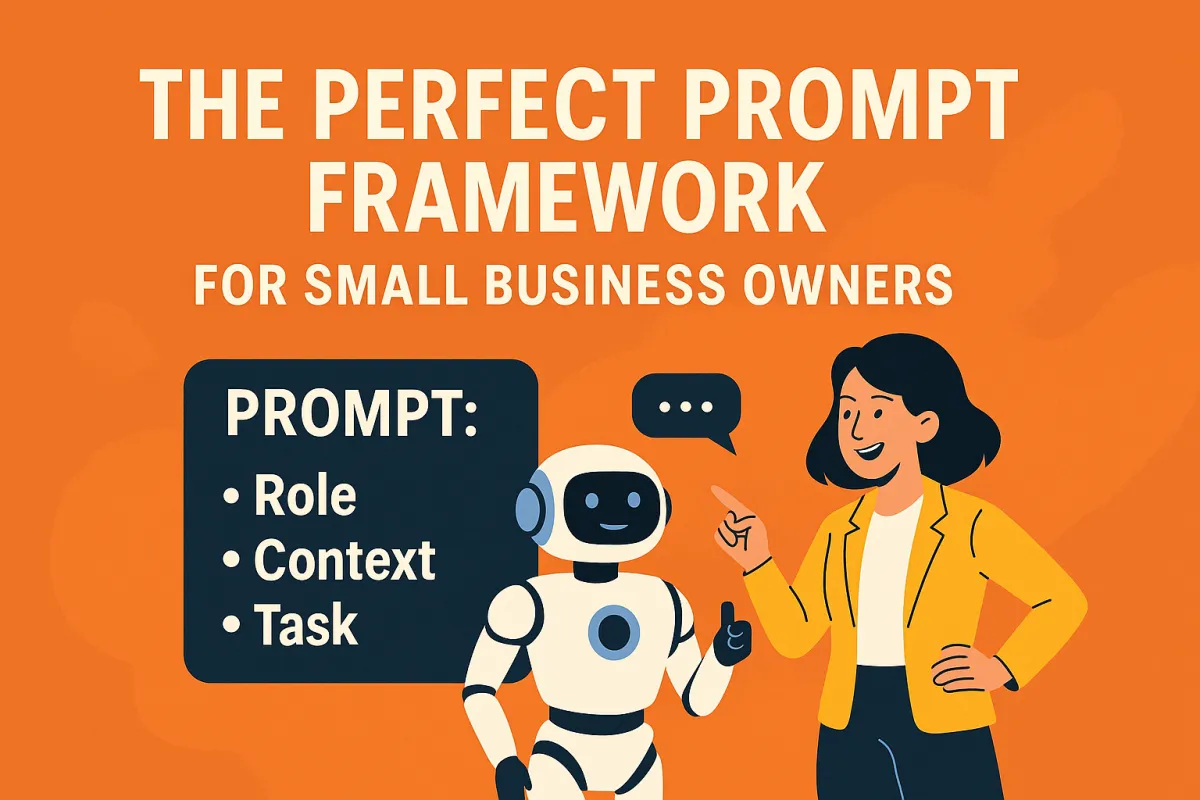
The Perfect Prompt Framework: AI Success Method
TL;DR (Short Version)
Most AI prompts fail because they’re vague, incomplete, or missing context. The “Perfect Prompt Framework” fixes that by:
Giving the AI a clear role
Providing essential context
Using delimiters for clarity and safety
Breaking big tasks into smaller steps
Leading the AI like a director, not a passive user
This article breaks down each principle in everyday small-business terms, shows examples, and gives you plug-and-play prompts you can start using immediately.
Audio Overview
Executive Summary
Small business owners are finally discovering what early adopters already know: AI doesn’t save you time unless you know how to talk to it. The biggest frustration? Asking an AI for help and getting something totally off-base.
The “Perfect Prompt Framework” is a simple method built around clarity, structure, and direction. Instead of guessing what to say to the AI, this framework turns every prompt into a repeatable formula:
Role → Who the AI should mimic
Context → The information it must use
Delimiters → Clean structure
Step-by-step or chained tasks → Fewer errors
Director mindset → You’re leading, not hoping
This article explains how the framework works, why it matters for every small business, relatable real-world examples, and a dedicated section of small-business prompts you can use right away.
The Perfect Prompt Framework for Small Business Owners
4 Surprising Secrets to Getting Exactly What You Want from AI
Let’s be honest…
You’ve probably asked an AI for help at some point and gotten a response that made you think:
“What… is this? This isn’t even close to what I asked for.”
You’re not alone. Every small business owner from landscapers to consultants runs into this.
The problem isn’t you.
It’s not even the AI.
It’s the prompt.
AI doesn’t read your mind.
It responds to instructions.
And when your instructions are broad, incomplete, or vague… the results will be broad, incomplete, or vague.
But the good news is: prompting is a skill anyone can learn, and the Perfect Prompt Framework makes it ridiculously easy.
Let’s break down the four secrets—each one tailored specifically to busy small-business owners juggling too many things already.
Secret 1: The Magic Isn’t Complexity — It’s Simplicity
Believe it or not, the most powerful prompts are built around just two pillars:
Tell the AI who to be.
Give it the context it needs.
That’s it.
Two steps.
Pillar 1: Give the AI a Role
This is where the magic happens.
Telling the AI who to be focuses its “attention” instantly—almost like handing it a map.
It’s the difference between saying:
❌ “Write a marketing email.”
vs.
✅ “You are an expert email copywriter who specializes in small business promotions.”
That one change can double or triple the quality of the output.
Pillar 2: Give It the Right Background
AI needs context.
Without it, you’re essentially saying:
“Help me… but I’m not going to tell you anything you need to know.”
Context includes things like:
Your business type
Your target customer
What makes your offer valuable
The tone you prefer
Any examples you like
Give AI more context → Get better results.
Every. Single. Time.
Secret 2: How Delimiters Make Your Prompts ‘Surgically Precise’
Delimiters are simple symbols you use to organize your prompt clearly:
""" text """--- text ---<<< text >>>
Think of them like section dividers in a binder.
They tell the AI:
This is the background
This is the task
This is the tone
This is the example
You eliminate 99% of misunderstanding by using delimiters.
The Hidden Benefit: Protection from Prompt Injection
Most people don’t know this:
Delimiters also protect your instructions from being “hijacked” by accidental or malicious text inside the prompt.
It’s a simple technique with a big upside.
Secret 3: To Accomplish Big Tasks, Think Smaller
When you ask an AI:
“Write me a full blog post, a newsletter, three ads, and a social media plan…”
It can do it—but not well.
Large tasks overwhelm even advanced AI models.
Instead, you have two options:
Option A: The Mega Prompt
One giant prompt with everything included.
Great for medium tasks.
Risky for big ones.
Option B: The Prompt Chain (my favorite)
A series of smaller prompts where each step builds on the last:
First: “Create an outline.”
Then: “Write the introduction.”
Then: “Write Section 1.”
Then: “Write the conclusion.”
Fixing or revising one step at a time = far less frustration, far better results.
For small business owners, this might be the single biggest unlock.
Secret 4: You’re Not Just a User — You’re the Director
This is the biggest mindset shift.
Most people use AI like this:
“Um… can you maybe help me with something?”
No.
You’re the director.
You’re the boss.
You tell the AI:
Who to be
How to behave
What the goal is
How to format the response
What tone to use
Think of AI as your highly skilled assistant waiting for direction.
You’re in control.
The moment you step into that role, everything changes.
Small Business Prompts You Can Use Right Now
Below are structured prompts inspired by the style and clarity found in your prompt library.
They’re plug-and-play, and each uses the Perfect Prompt Framework.
✅ 1. Customer Review Response Prompt:
Prompt:
You are a customer service expert who specializes in small business communication.
Here is the context you need:
Business type: [insert your business type]
Tone: Warm, professional, and solution-focused
Customer review: “[paste review here]”
Write a personalized response that acknowledges their message, reinforces our brand values, and invites them back.
✅ 2. Marketing Email Prompt:
Prompt:
You are a professional email copywriter who specializes in small business promotions.
Here is the context:
Business: [describe your business]
Offer: [describe the offer]
Target customer: [describe ideal buyer]
Tone: Energetic, confident, and motivating
Goal: Increase sales of this offer
Write a persuasive marketing email with a strong hook, three benefit-driven sections, and a clear call to action.
✅ 3. Social Media Content Calendar Prompt (Non-Code Version)
Prompt:
You are a social media strategist for small businesses.
Here is the context:
Industry: [insert industry]
Audience: [describe your customer]
Goal: Grow visibility and engagement
Timeframe: 30 days
Create a 30-day content calendar that includes:
Post type
Topic
Caption idea
Recommended platform
Optional: hashtag suggestions
✅ 4. Website Homepage Copy Prompt (Non-Code Version)
Prompt:
You are a professional website copywriter who specializes in high-converting small business websites.
Here is the background:
Business: [insert business]
Audience: [insert target customer]
Unique value: [insert what makes you different]
Tone: Friendly, trustworthy, and clear
Write homepage copy that includes:
A bold headline
A supportive sub-headline
A value-focused section with benefits
A clear call to action
✅ 5. Small Business Advertising Prompt
Prompt:
You are a paid advertising specialist who writes short, catchy ads for small businesses.
Here is the context:
Business: [insert]
Offer: [insert]
Audience: [insert]
Tone: Bold, benefit-driven, and attention-grabbing
Write three short ad variations (under 20 words each) for testing on Facebook or Instagram.
Why This Framework Changes Everything for Small Business Owners
Small business owners don’t have time to waste.
This framework:
Reduces back-and-forth
Eliminates unclear outputs
Saves hours each week
Improves marketing consistency
Helps you create professional-level content in minutes
Works no matter your industry
If you learn just ONE skill this year…
Make it prompting.
It’s the modern version of learning email in 1999.
A fundamental skill.
A career-level unlock.
A business multiplier.
Conclusion: Now You’re the Director — What Will You Create?
Using AI doesn’t have to feel like guesswork.
With the Perfect Prompt Framework, you have a repeatable structure that gives you:
Better content
Faster results
Cleaner communication
More creativity
And more confidence
You’re not wandering into the “AI library” hoping for a good answer.
You’re walking in like a boss and saying:
“Here’s who you are.
Here’s what you need to know.
Here’s what I want.
Now go do it.”
And it works.
Every. Single. Time.
FAQ (Small Business Edition)
1. How long should a good AI prompt be?
Long enough to give context, short enough to avoid clutter. Most great prompts are 3–8 sentences.
2. Do delimiters really matter?
Yes — they reduce errors dramatically and keep your instructions organized.
3. Should I use mega prompts or prompt chains?
For big tasks (blogs, strategies, scripts), prompt chains are far more reliable.
4. Can I reuse prompts?
Absolutely. Save your best prompts and use them as templates.
5. Is this framework good for non-tech-savvy owners?
Yes. In fact, simplicity is the entire point. Zero technical knowledge needed.
6. Can this help with marketing?
It helps with ALL marketing — emails, posts, ads, SEO content, customer responses, and more.
Want More Support? Join Our Free AI Community
If you want more prompts, tutorials, and small business AI strategies, join my free community here:
👉 https://offers.strategicdigital.co/leveraging-ai-community
Come learn, experiment, and grow with other small business owners using AI to level up their marketing and operations.







CONTACT
SUBSCRIBE TO MONTHLY Strategic Digital Copyright MAGAZINE